Two methods to detect refrigerant leaks in AC/R systems
Refrigerant gas leaks can depend on several causes. Repeated vibrations, corrosion, and improper installations, for instance, can lead to wear of seals, junctions and components of AC/R system and the consequent formation of micro-leaks.
Refrigerant leaks tend to be noticed because the AC/R system does not work efficiently, cooling less and consuming more energy.
Finding these leaks is therefore essential to restore the system’s energy consumption to its original level and to protect the environment from the dangerous consequences linked to the release of refrigerants into the atmosphere.
To identify refrigerant leaks in AC/R systems, technicians use different methods that can be classified in two macro-categories:
1) Internal detection: this process involves placing dye into the AC/R system;
2) External detection: this method involves examining the external piping surfaces of the systems and it can be carried out either spraying a soapy solution on them or using an electronic leak detector.
UV dyes are universally recognised for their ability to detect leaks even under low visibility conditions. However, many of the UV dyes on the market contain solvents in which chromatophore pigments are dissolved, which can damage aluminium, plastic and rubber components of AC/R systems. Besides, some solvents, such as Aromatic200 and N-Methyl-2-pyrrolidone (NMP), are carcinogenic and toxic.
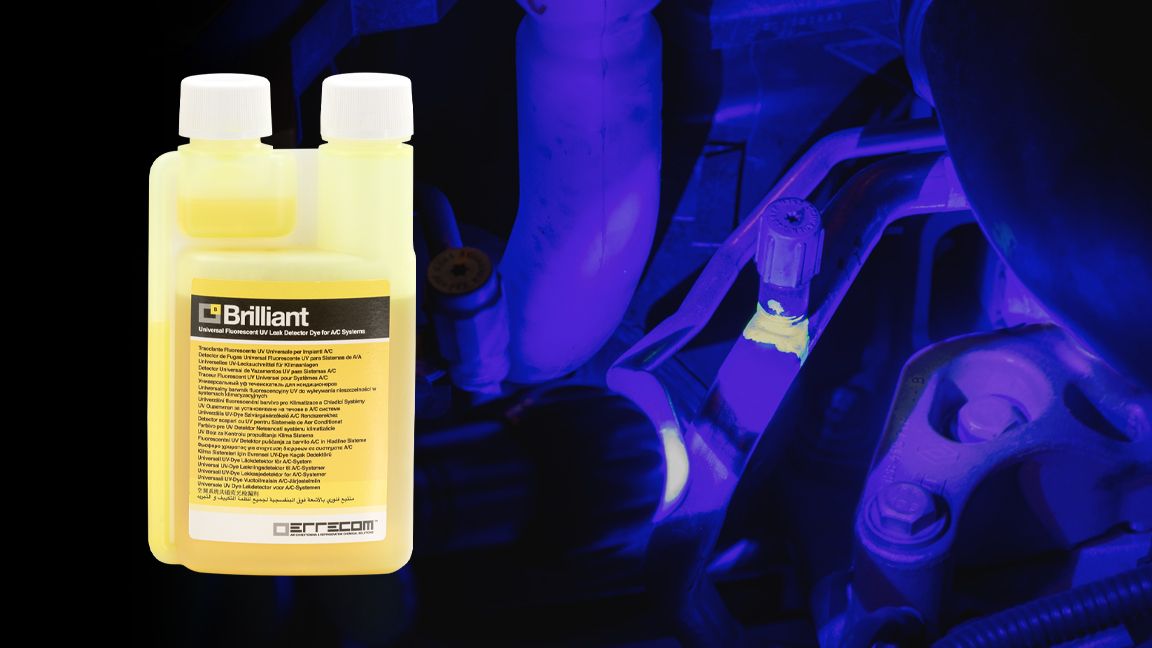
To provide a safe product for the system and technicians, Errecom has formulated Brilliant. Like all Errecom dyes, Brilliant is non-toxic as it is solvent-free and complies with SAE J2297 and SAE J2298 standards. Available in different versions: for automotive A/C systems with R12, R134a, R1234yf, and electric compressors as well as for the HVAC/R sector compatible with all lubricants and refrigerant gases including CFC, HFC, HCFC, HFO, CO2, and Hydrocarbons.
Once placed into the system to be examined, Brilliant locates refrigerant gas leaks with extreme precision. When illuminated by a UV lamp, leaks appear as fluorescent spots: that’s why Brilliant is highly recommended for checking systems located in dimly lit areas. Moreover, as it is inserted inside the system, it guarantees a complete examination even in the most difficult to reach areas. Besides, if not removed, Brilliant’s action continues over time, pinpointing any leaks that may have developed later.
To meet the needs of technicians who prefer to proceed differently, Errecom has developed solutions to detect leaks from the outside.